

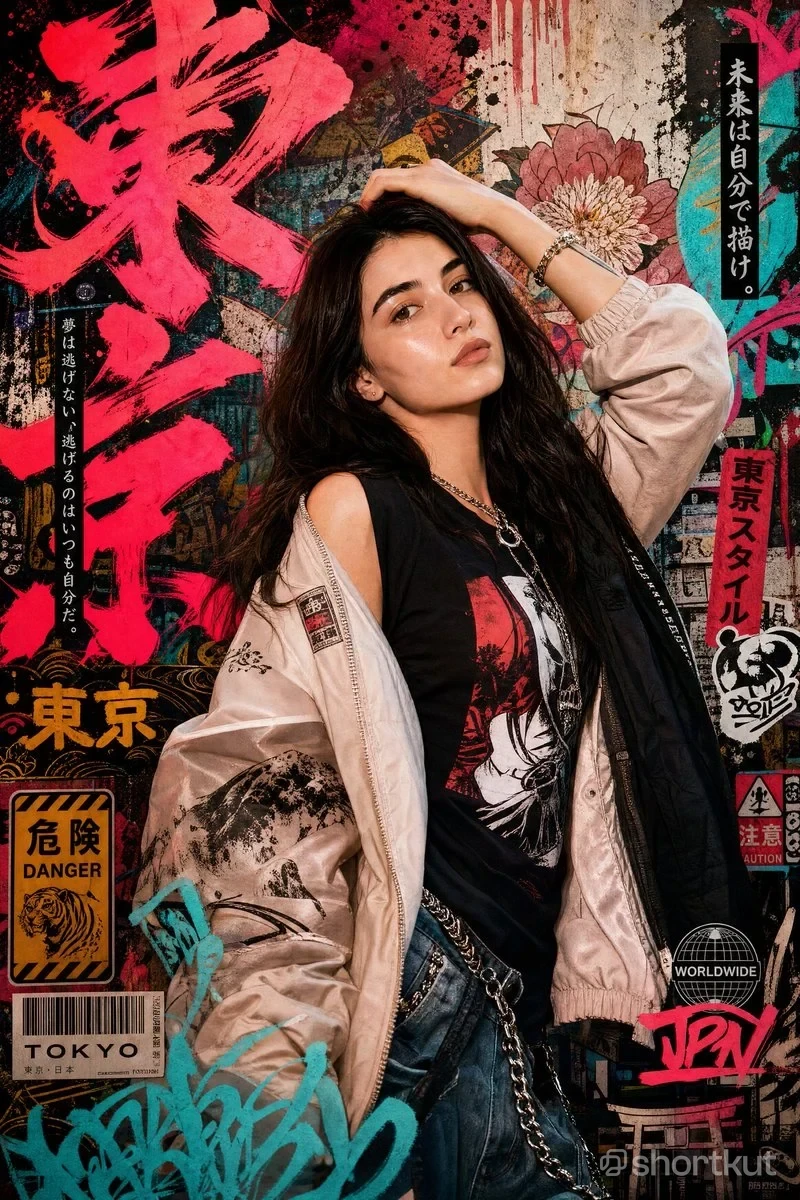
This version needs **only the user’s photo**. It explicitly prioritizes keeping their face unchanged. Exact facial preservation and an identical poster layout still can’t be guaranteed by a prompt alone.

Create a detailed Japanese streetwear editorial poster using the uploaded photo as the sole identity reference.

FACE PRESERVATION — HIGHEST PRIORITY
The person must remain unmistakably the same person in the uploaded photo. Preserve their face as it appears: facial proportions, face shape, eyes, eyelids, eye spacing, eyebrows, nose, lips, jawline, cheeks, ears, skin tone, age, facial hair, and distinguishing marks. Keep natural skin texture and asymmetry. Do not beautify, retouch, slim, reshape, smooth, age, or reinterpret the face. Preserve their hairstyle and hairline.

Keep the original facial expression, gaze direction, and head angle to avoid changing facial features. Where supported, retain the original face pixels and build the new image around them. Adapt the body pose and lighting to the face rather than regenerating the face to fit the scene. Do not copy the uploaded photo’s clothing or background.

FORMAT AND COMPOSITION
Vertical 2:3 portrait poster, edge-to-edge artwork with no border. Frame the person from above the raised hand to the upper thighs. Position them slightly right of center, filling approximately three-quarters of the canvas width. Place the face near the upper-middle area, around 52% of the canvas width and 28% of its height. Keep the entire face unobstructed and leave visible collage graphics along both sides.

POSE
Create a relaxed fashion-editorial stance with the torso angled slightly, one arm raised overhead and its hand resting naturally on the crown of the head. The raised elbow points toward the upper-right corner of the image. The other arm hangs loosely downward. Adapt this pose to the uploaded face’s existing head angle and expression. Maintain believable anatomy and natural proportions.

CLOTHING AND ACCESSORIES
Dress the person in an oversized pale blush-beige satin bomber jacket, worn open, with voluminous sleeves, gathered cuffs, small stitched patches, and distressed black ink illustrations on the sleeves. The jacket slips slightly off the shoulder on the viewer’s left.

Underneath, use a black sleeveless graphic top featuring a large red, white, and black manga illustration. Add faded blue jeans, a silver chain hanging from the waistband, a silver necklace with circular hardware, and a silver wrist bracelet. Make the fabric folds, stitching, satin reflections, and metal details realistic. Fit the outfit naturally to the person.

BACKGROUND
Build a dense, layered Japanese urban poster collage on aged cream paper. Combine torn paper edges, black ink splashes, weathered screen printing, scratches, faded stamps, paint drips, and overlapping street stickers. Use deep black, hot coral-red, dusty beige, turquoise, and small mustard-yellow accents. The background must feel like a flat, heavily pasted street-art wall.

LAYOUT OF GRAPHIC ELEMENTS
• Left side: enormous hot coral-red Japanese brush characters, stacked vertically and cropped by the top and left edges. Use thick, rough brush strokes with broken ink texture.
• Upper right, behind the raised arm: a large muted dusty-pink Japanese peony illustration with cream details and dark outlines.
• Top-right edge: a narrow black vertical strip with white Japanese lettering reading “未来は自分で描け。”
• Left-middle edge: another narrow black strip with small vertical white Japanese lettering.
• Right-middle edge: a red vertical paper label with bold black text reading “東京スタイル”.
• Lower-left area: mustard-yellow “東京” lettering above a weathered yellow warning sticker. The sticker has black diagonal hazard stripes, “危険”, “DANGER”, and a small black tiger illustration.
• Beneath the warning sticker: an aged cream barcode label with widely spaced black “TOKYO” lettering.
• Lower right: a small white outlined globe with “WORLDWIDE” across its center.
• Below the globe: a bold coral-red spray-painted tag.
• Bottom-right background: a partially cropped Japanese torii-gate illustration.
• Bottom-left foreground: large turquoise graffiti strokes overlapping the lower jacket and jeans, never the face.
• Scatter smaller torn labels, black paint marks, and turquoise brush accents between these elements.

LIGHTING AND STYLE
Keep the person photorealistic, with detailed hair, natural skin texture, believable hands, and visible fabric texture. Use direct fashion-editorial flash with warm highlights and deep shadows on the clothing, while keeping the uploaded face’s appearance intact. Match the surrounding lighting and color treatment to the face. The background should have rough printed textures and high contrast.

The finished result should look like a photographic streetwear portrait integrated into a distressed Japanese graphic poster. Keep the palette dominated by coral-red and black, balanced by beige paper and turquoise graffiti.

AVOID
Any change to the person’s identity or facial features; face blending with another person; artificial symmetry; beauty filters; waxy skin; altered facial hair; changed hairstyle; cartoon or illustrated skin; distorted anatomy; extra fingers; extra people; graphics covering the face; clean minimalist backgrounds; neon city scenes; excessive blur; watermarks.

Generate one finished vertical poster. If any styling instruction conflicts with preserving the uploaded face, prioritize preserving the face.

NewPrompts
Hyper Realistic 3D Render in the Style of Pixar Animation
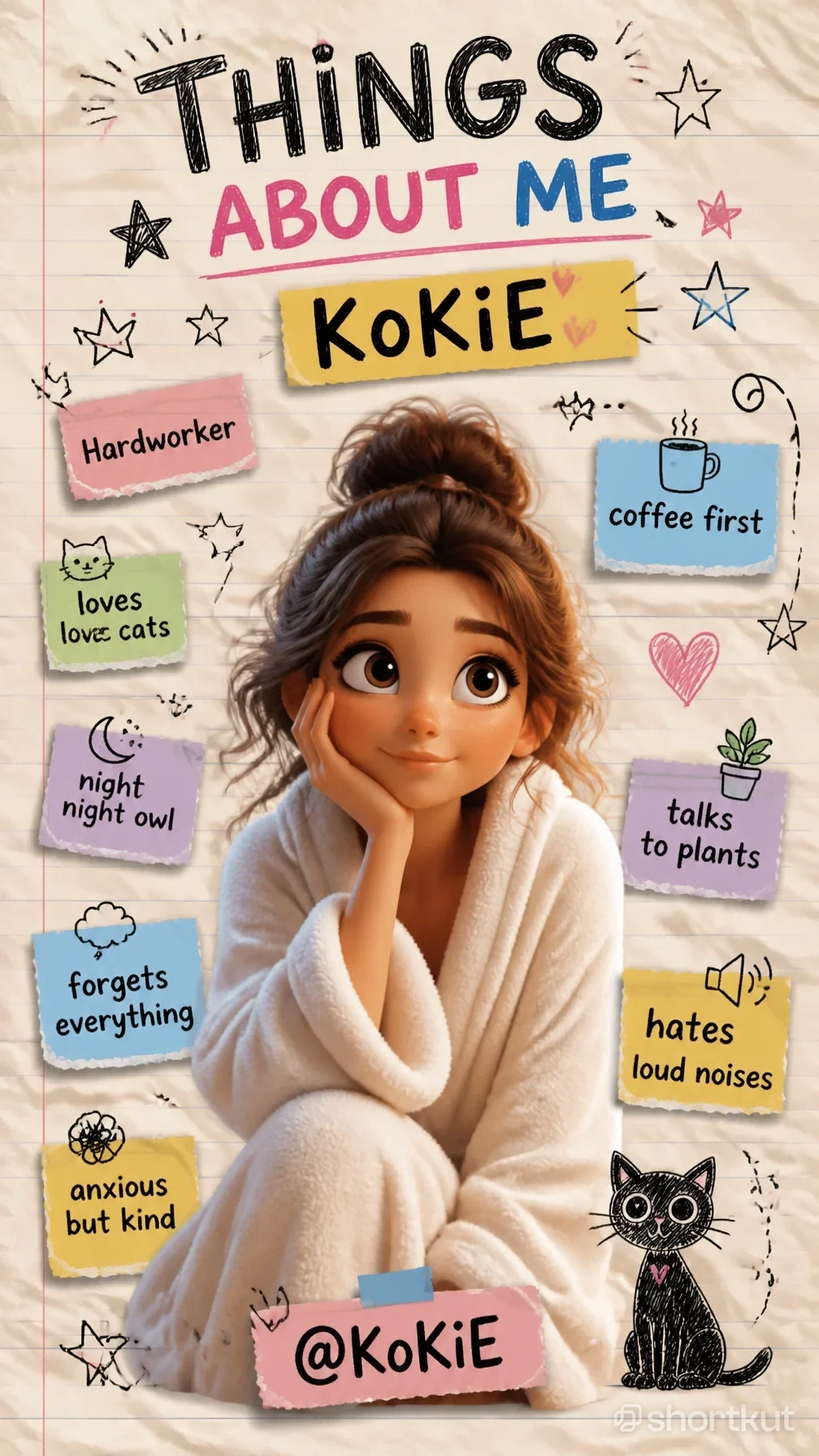
Create a personalized 3D character scrapbook poster using the uploaded person’s photo as the sole identity reference. No additional style-reference image is needed.CUSTOMIZETITLE LINE 1: [THINGS]TITLE LINE 2: [ABOUT ME]NAME: [KOKIE]HANDLE: [@KOKIE]LEFT NOTES, TOP TO BOTTOM:1. [Hardworker]2. [loves cats]3. [night owl]4. [forgets everything]5. [anxious but kind]RIGHT NOTES, TOP TO BOTTOM:1. [coffee first]2. [talks to plants]3. [hates loud noises]Use the supplied wording exactly, without printing the brackets. Omit any blank field and rebalance the layout. Do not repeat words, invent additional personality traits, or add unrelated text.IDENTITY AND 3D TRANSFORMATIONTransform the uploaded person into a polished, expressive 3D animated character while preserving their recognizable identity.Retain the person’s distinctive face shape, skin tone, eye color, eyebrow shape, nose, lips, hairline, hair color, and identifying features. Preserve facial hair and glasses if present. Translate these features into coherent three-dimensional character design.Use gently enlarged expressive eyes, rounded facial forms, softly sculpted cheeks, a simplified but recognizable nose, and a subtle friendly smile. Keep the characteristic spacing and relationships between features so the result looks like a stylized version of the uploaded person.The entire face must use the same 3D rendering style as the hair, ears, neck, hands, and body. Do not paste a photographic face onto an animated body. Do not replace the person with a generic cartoon character, change their ethnicity, or turn an adult into a child.Use warm skin shading, subtle subsurface scattering, soft highlights, glossy eyes with clear catchlights, and dimensional hair strands grouped into natural sculpted locks. Avoid plastic toy surfaces and exaggerated caricature.FORMAT AND COMPOSITIONVertical 9:16 poster, designed as a handmade notebook scrapbook page.Use warm cream, lightly crumpled paper with fine horizontal pale-blue notebook rules and one thin faded-red vertical margin line near the left edge. Show realistic paper fibers, gentle wrinkles, and softly shaded creases.Divide the composition into:• Top quarter: large hand-drawn headings and a torn-paper name label.• Middle and lower area: the seated 3D character, surrounded by small personality-note cards.• Bottom: a taped handle label in front of the character and a hand-drawn cat at the lower right.The character occupies roughly the central 60% of the width. Keep the face near the horizontal center, about 46% down the canvas. Arrange notes beside the character without covering the face.CHARACTER POSE AND CLOTHINGSeat the character comfortably with one bent knee raised in the foreground. Lean their cheek into the palm of the hand on the viewer’s left, with the elbow supported naturally by the raised knee. Keep the other arm relaxed near the lap.Angle the eyes slightly upward toward the viewer’s right, with a gentle, thoughtful smile. Maintain believable hand anatomy and a softly compressed cheek where the palm touches it.Dress the character in a plush ivory fleece bathrobe with a thick folded collar, oversized sleeves, and a closed, comfortably wrapped front. Render fine fuzzy fibers, soft folds, and warm shadows. Keep the pose cozy and fully covered.Preserve the source hairstyle’s defining characteristics. If the person has long hair, loosely gather it into a messy high bun with a few face-framing strands. If their hair is short, retain its length and recognizable silhouette rather than inventing a bun.HEADER DESIGNPlace TITLE LINE 1 across the top in very large, irregular black uppercase lettering, with visible scribbled crosshatching inside the strokes. Give the letters a playful hand-drawn rhythm.Below it, place TITLE LINE 2 in bold, slightly uneven uppercase lettering. For the default “ABOUT ME,” use dusty pink for “ABOUT” and medium blue for “ME.” For replacement wording, distribute these two colors across the words while keeping the t
Comments